





The Organizational Coaching Maturity Model (OCMM) is Meeraq’s structured assessment framework designed to help organizations understand how deeply coaching is embedded into their culture, leadership, and ways of working.
As organizations invest more in coaching and leadership development, a key challenge remains — understanding whether these efforts are creating meaningful and sustained impact.
The OCMM Assessment helps organizations evaluate their current coaching ecosystem, identify strengths and gaps, and uncover opportunities to build a more scalable and sustainable coaching culture.
Rather than treating coaching as a standalone initiative, OCMM examines how coaching is embedded across leadership behaviors, systems, processes, adoption, and organizational mindset — offering a holistic view of coaching maturity.
Uncover the steps needed to build a stronger, more scalable coaching culture.
Step 1. Why Organizations Need This?
Why It Matters
Without a clear framework, coaching initiatives can become fragmented, inconsistent, and difficult to scale. It also becomes challenging to assess whether leaders are effectively applying coaching in their day-to-day work and whether these efforts are aligned with broader business and leadership goals.
The OCMM Assessment helps organizations move from isolated coaching efforts to a more intentional, organization-wide coaching culture. It equips leaders and HR teams with the clarity to make informed decisions, strengthen leadership capability, and build development ecosystems that drive meaningful business impact.
Step 2. Understanding the OCMM framework
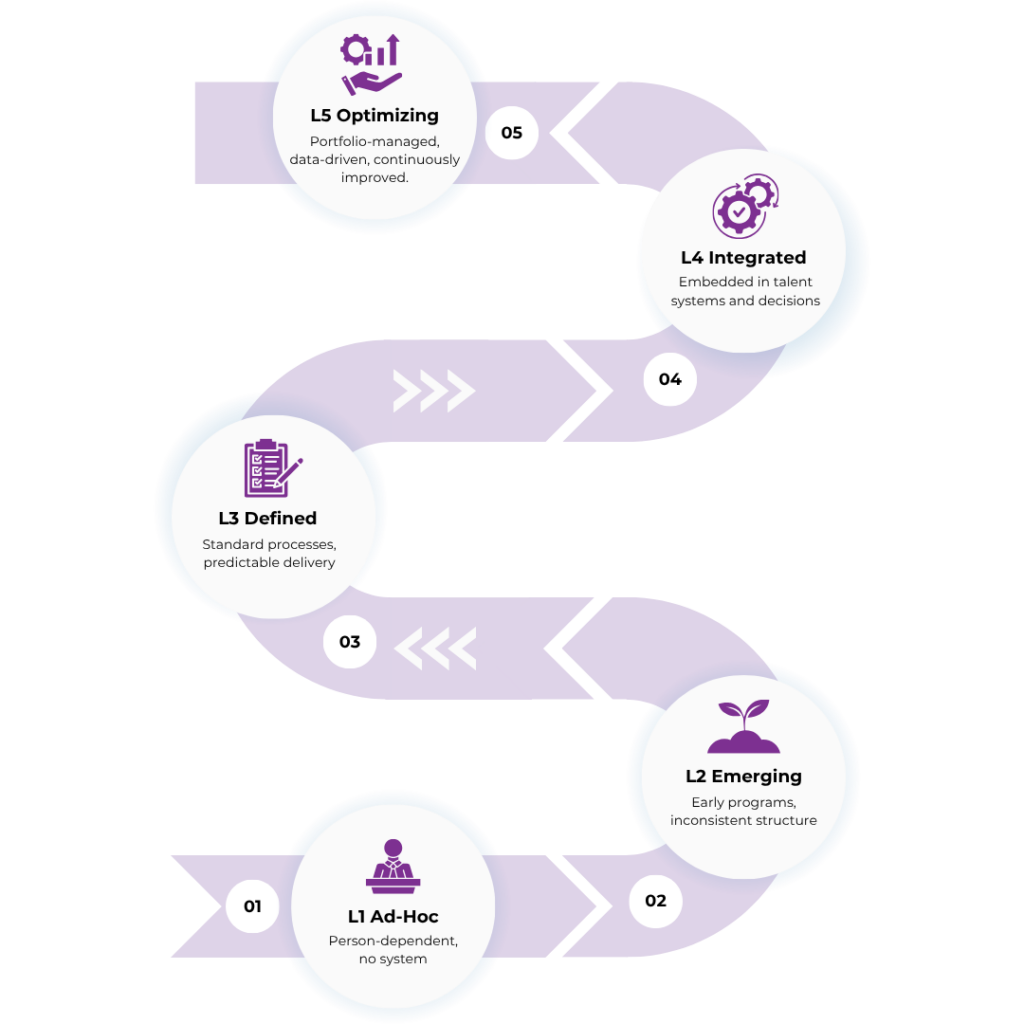
OCMM provides a clear view of where an organisation stands today, along with insights on how to strengthen and scale coaching in a meaningful way.
Level 1: Ad-Hoc Coaching happens because a few people want it, not because the system enables it.
Level 2: Emerging First moves from individuals to programs; early structure appears, but inconsistently.
Level 3: Defined Common language and standard ways of working; coaching is predictable and auditable.
Level 4: Integrated Coaching is part of how the organization runs its people systems and makes decisions.
Level 5: Optimizing A learning system-coaching is portfolio-managed with evidence, and continuously improved.
Step 3. What can you discover from an OCMM assessment?
- Assess Maturity: Evaluate how coaching is currently practiced across key organizational metrics
- Identify Gaps: Pinpoint areas limiting impact—from leadership alignment to adoption and governance
- Benchmark Progress: Understand where you stand against industry standards and best practices
- Enable Transformation: Move from fragmented initiatives to a structured, scalable coaching ecosystem
Step 4. Who is this for?
The OCMM Assessment is designed for organizations investing in coaching, leadership development, and culture transformation initiatives.
It is especially valuable for:
- CHROs and HR leaders
- Learning & Development teams
- Leadership development professionals
- Organizations building internal coaching capability
- Enterprises looking to scale coaching initiatives
- Teams focused on culture transformation and employee development
Whether your organization is just beginning its coaching journey or strengthening an existing ecosystem, the OCMM Assessment provides the clarity needed to move forward strategically.
The 8 Domains of Coaching Maturity
The OCMM Assessment evaluates coaching maturity across eight critical organizational dimensions. Together, these domains provide a comprehensive understanding of how coaching is integrated into leadership, culture, and day-to-day ways of working.
- Clarity
- Prioritisation
- Funding
- Executive ownership
- Workflow design
- Talent system linkage
- HiPo & succession
- Policy
- Confidentiality norms
- Supervision structures
- Quality assurance
- Clarity of metrics
- Evidence of impact
- Learning loops
- Data-informed decisions
- Training design
- Reinforcement in 1:1s
- Measurable adoption
- Ecosystem design
- CPD pathways
- Deployment logic
- Performance feedback
- System of record
- Privacy protocols
- Analytics capability
- Investment decisions
- Psychological safety
- Peer coaching norms
- Leadership modelling
- Cultural embedding
